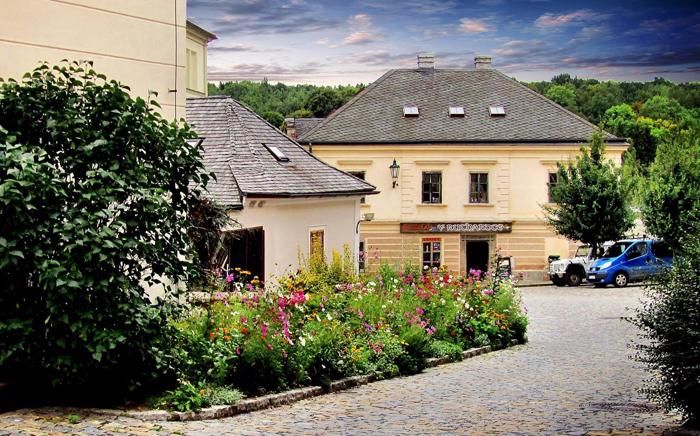


7/ Restaurant V Ruthardce
The stylish medieval restaurant with a unique view of St. Barbara's Cathedral or the highest church of Kutná Hora, attracts not only with its delicious offer but also with its very interesting history.
The two-storey house, which in ancient times was called the Old Deanery or also the Priests' House, has a Gothic core (cellars, portico, and cellar window), and the entrance to the garden from Ruthardka is equipped with a broken Gothic portico. In the 3rd quarter of the 18th century, it was rebuilt in Baroque style and after a fire in 1886, the house acquired its present Classicist appearance. Although the house has undergone many changes, it still retains the unique charm of the old days.
The restaurant, the main room of which is designed in a rustic medieval style, while the second room resembles more of a middle-class residential kitchen from the turn of the 19th and 20th centuries, has been operating here since 2005 and has been opened in parts and rooms as they were gradually completed. The restaurant was originally conceived as a quiet and welcoming gathering place for friends of the owner, but enormous interest from local residents led to an extension to include a conservatory.
Learn more
ABOUT THE EMBLEM OF THE HOUSE OF RUTHARD:
According to the story loosely retold by the restaurant's official website, three Ruthard brothers, Jan Kunklín, Jiří and Mikuláš, lived in Kutná Hora during the reign of King Wenceslas II. Their wealth came from the Ruthart and Sekhart mines and was enormous.
Jan Kunklín Ruthard owned a manor behind the town at Kolmarka (now Karlov). Here he invited King Wenceslas II, who often stayed at the Vlach court, to visit him with his whole retinue.
After a sumptuous luncheon, Ruthart led the king into his deep cellars, and he was astonished at the vast wealth he saw. The cellars were filled with silver bars and money. Silver loaves were piled high.
"Whose is it, Ruthard?", asked the king in astonishment.
"Mine, thy subject," replied Ruthard, "but point to any treasure and it shall be thine, O gracious king! I know not how else to thank thee for the honour thou hast done my house." The king graciously beckoned to him, and said: "We have no need of it for that time. But if one day the need should come upon our country, we know that we can take refuge with thee for help."
Then they rode together to the Sedlec monastery. On their way through the meadows, the king asked whose they were. "They are yours, gracious king. And I use them for the wages I must pay to the abbot of the monastery. Please plead with the abbot to be content with a smaller groschen." The king smiled, and, as a sign that he was willing to comply with the request, he broke off a twig and handed it to Ruthard: "Let this twig remind thy descendants also of the willingness thou hast shown me in offering me thy treasures."
While the king was late in visiting the abbot, Ruthard hastened to the city and had the royal hand painted with a shield. When Wenceslaus saw his shield, he confirmed the arms, which the Ruthard family then boasted until their extinction.
It is said that Jan Kunklín Ruthard, together with Bořita of Košice, founded the Church of St. James in 1310 on the site of the former chapel. His coat of arms can still be found in several places in the south aisle of the church.
Map







Included in Tours
More information
Opening hours
Sunday - Thursday:
11:00 - 23:00
Friday and Saturday:
11:00 - 24:00