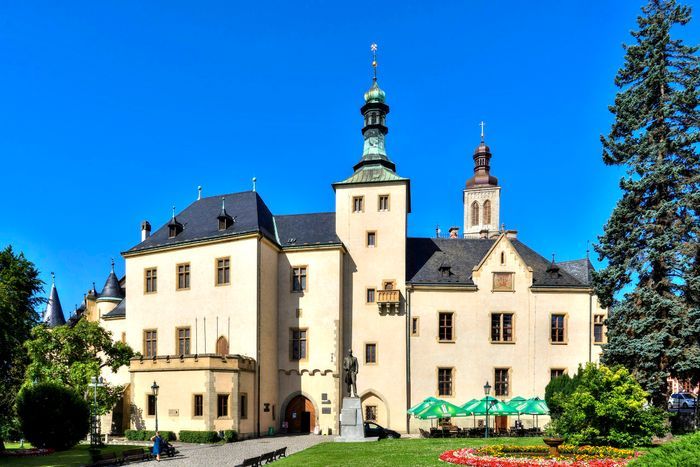


10/ Vlašský Court
Initially, a simple fortification that was designed to protect the trade route, later a royal mint and a royal palace built by King Wenceslas II at the end of the 13th century, these stories and many others are hidden behind the walls of the Vlašský dvůr.
In 1300, King Wenceslas II issued a coinage reform, which included, among other things, the closure of small mints scattered throughout the Czech Kingdom and the introduction of a new coin, the so-called Prague grosz. The production of this currency was, for logical reasons, concentrated in the vicinity of the richest source of silver in the country – the newly established mint in Vlašský dvůr in Kutná Hora, which thus gained a privileged position in the whole kingdom. The reconstruction of the whole complex is related to this new role. A central minting hall was built here, with a floor above it occupied by the king, and small and cozy mint rooms were created around the perimeter walls of the court. At the beginning of the 15th century, Kutná Hora, and more specifically the Vlašský dvůr, became an increasingly popular place for King Wenceslas IV, who had representative and living quarters built here, with a tower and a chapel in which he had the royal treasures placed. The new splendor and refinement of the state rooms begged to host special occasions, which they did. In 1409 the Decree of Kutná Hora was signed here, in 1444 the future Czech king George of Poděbrady was elected supreme governor of the East Bohemian landfries and in 1448 the provincial administrator, or the election of Vladislav Jagiellon as Czech king in 1471.
As the local mining declined and the importance of Kutná Hora declined, Vlašský dvůr also lost its importance and thus slowly decayed. It was not until the end of the 19th century that the architect Ludvík Lábler restored it in a Neo-Gothic purist form. Among his collaborators was the sculptor and carver Jan Kastner, whose Neo-Gothic furnishings (furniture, architecture of the altars in the chapel) are so perfectly styled that art historians hardly distinguish them from the medieval ones.
Since the end of the 19th century, the building has been owned by the town and after reconstruction, it houses the offices of the town council.
Currently, the Wallachian Court offers three guided tours with interactive elements: the Mystery of the Lost Silver, the Royal Mint and the Royal Palace.